thePiperSHIHTZU

  • Subscribe to our RSS feed.
  • Twitter
  • StumbleUpon
  • Reddit
  • Facebook
  • Digg

Sunday, 10 July 2011

AFRICAN ELEPHANTS

Posted on 06:13 by Unknown
Here's how you can tell the difference between African elephants and Asian elephants:
1.  African elephants live in Africa and Asian elephants live in Asia.
2.  African elephants are bigger.
3.  Also, African elephants have bigger ears.
4.  Both male and female African elephants have tusks, but only male Asian elephants do.
5.  African elephants have two finger-like things at the tip of their trunks, and Asian elephants only have one.
6.  Asian elephants can be tamed, and they will carry heavy loads and do a bunch of work for people, but African elephants prefer being self-employed.


There are two different species of African elephant, and one is called the African Bush Elephant or Savannah Elephant (Loxodonta africana), and the other is called the African Forest Elephant (Loxodonta cyclotis).  The word loxodonta is Greek, and it means "oblique-sided tooth."


An elephant has four molars to chew with.  Each one weighs about 11 pounds and is 12 inches long.  Okay, now here's the interesting thing:  when the front two molars get all worn down, they fall out, and the other two molars move forward to take their place.  Meanwhile, two brand-new molars grow in in the back of the mouth.  An elephant gets new teeth 6 times, and then by the time it is between 40 and 60 years old, it doesn't have any teeth left, and it starves to death.


The elephant's tusks are actually the second set of incisors that grow out really long.  A baby elephant starts growing tusks when it is about 2 years old. There are many good uses for tusks, such as digging up roots, tearing bark off of trees, herding young, and poking around in the ground to find water.  Also tusks can be used as weapons in a fight.  They weigh between 51 and 99 pounds, and they can be from 5 to 8 feet long.

The bush elephant is the biggest of all land mammals.  Males are 10--13 feet tall at the shoulder, and they weigh from 13,000 to 20,000 pounds.  Females are 7.2--8.5 feet tall and weigh 4,800--7,130 pounds.  The very largest elephant that we know about was a male that was shot in Angola in 1965.  He weighed 27,060 pounds and stood 13.8 feet high.   This elephant got stuffed and mounted, and now you can see him in the National Museum of Natural History in Washington, D.C.


Elephant skin is super thick and leathery.  It is made that way so it can help the elephant keep cooler.  Also an elephant's ears are really big, and when the elephant flaps its ears, the blood in all the blood vessels in the ears gets cooled off.  Elephants have really good hearing, but their eyesight is not so great. They usually move along at about 4 mph, but if they are scared or upset, they can run as fast as 25 mph.

Of course, the thing that makes elephants really special and different is that they have trunks.  The trunk is a combination of what would be the nose and the upper lip of any other animal.  Elephants' trunks are about 7 feet long, and they are very muscular and strong.  Trunks are used for eating, drinking, and taking dust baths or water baths.  When elephants drink, they suck up as much as 2 gallons of water into their trunks and then squirt the water into their mouths.

Also the trunk can show what sort of mood an elephant is in, sort of like a dog shows its mood with its tail.  Elephants can punch and push with their trunks.  And sometimes they wrap their trunks together in a sort of hug.  Elephants also have a very good sense of smell, so they can do things like find water that is out of sight under the ground.

Elephants are very smart, and they are also very social.  A herd of elephants is usually made up of females and their young, with the oldest female as their leader.  This leader is called the matriarch, and she's the one who decides where the herd goes.  She knows how to find all the water sources, and she teaches the locations to the other members of the herd.  When one of the elephants gives birth, all the other females come and touch the baby with their trunks.  And when an elephant dies, the others will stay by its body for a while.

A female can come into season at any time of the year, and when she does, she starts sending out something called infrasounds, and that makes lots of males come around.  They fight with each other, and whoever wins gets to mate with the female.  Then after 22 months, a baby elephant is born.  This is the longest gestation period of any mammal.  The baby weighs about 220 pounds when it is born, and it will nurse until it is 5 years old.  But it will also eat solid food, starting at about 6 months old.  Adult elephants don't have any natural predators to worry about, but they have to keep the young elephants safe from lions, crocodiles, leopards, and hyenas.

Watering hole
Elephants eat lots and lots of food, but what they eat depends on where they live.  Mostly, they like to eat stuff like leaves off of trees and shrubs.  In one day, an elephant can eat as much as 660 pounds of vegetation.  But since elephants have lousy digestive systems, only about 40% of the food is actually digested.  The rest ends up being poop, which Mom is very happy that she doesn't have to pick up, but I think it might be nice to roll in it.  Elephants also drink a lot of water, like 50 gallons every day.

African elephants have a conservation status of VULNERABLE.  They have been hunted for their ivory tusks since at least the 14th century.  During all the years when Africa was under colonial rule, the Europeans exported ivory so that they could make things like piano keys and billiard balls out of it.

Fang Traders With Ivory
When the World Wars came along, people stopped exporting ivory for a while, but in the 1970s, Japan started using raw ivory to make name seals.  The ivory was also used for making souvenirs, jewelry, and trinkets.  By the 1980s, Japan was using about 40% of the ivory coming from Africa, Europe and North America used another 40%, and most of the rest of it stayed in Africa.  In 1989, the export of ivory was outlawed, but there is still a lot of poaching going on, not just for tusks, but also for elephant meat and hides.  Oh, and there is also some trophy hunting.


Forest Elephants


Forest elephants live in west and central Africa, where there are still a lot of tropical rainforests.  Bush elephants live more in eastern and southern Africa, with the biggest bunches of them in Botswana, Tanzania, Zimbabwe, Kenya, Zambia, and South Africa.  In some areas, there are plenty of elephants, but in other places there aren't very many.  There are several protected areas for elephants, but less than 20% of the elephants' range is formally protected.


Elephant at the KC Zoo

Okay, well, this was a very BIG topic, so it's hard to say everything there is to say about elephants in one little blog entry.  I don't think I would want to see an elephant in person because I would be afraid the elephant would step on me, and then I would be as flat as a little black-and-white pancake!
Read More
Posted in | No comments

Saturday, 9 July 2011

MORE INTERESTING WORDS

Posted on 05:26 by Unknown

Well, it's time to learn about a few more interesting words and where they came from and why we might want to use them, so here goes!


FLABBERGASTED

You probably already know that this word means "surprised" or "astonished," and that it's a goofy-sounding word that's fun to use when you're talking or writing.  But do you know where the word came from?  I'll bet you don't, because nobody really knows exactly where flabbergasted came from.  What we do know is that it is an old word that has been around since at least 1772, which was the first year that it appeared in print.

The second part of the word, gast, is probably from the Middle English word gasten, which means "to terrify."  The word aghast also came from gasten.  And before gasten, there was the Old English word gast, which meant "spirit" or "ghost."  If you see a ghost, you might feel aghast, or you might turn as white as a ghost yourself.

But the first part of flabbergasted is harder to explain.  It might come from flap, which can be something that makes everybody get excited.  Like for example, "When the moose ran through the room, it caused a big flap."  Or another idea is that if you are surprised or aghast, you might shake like you are a big, flabby mound of jelly.

So maybe one of those is the true explanation for where flabbergasted came from.  Or maybe somebody just made it up, and everybody thought it was a funny-sounding word, so they kept using it.


BLOVIATE

If you boast a lot and sound all pompous when you talk, then you are bloviating.  And you could also say you are blowing a lot of hot air.  Which is how this word got started, with the word blow and then an ending that is supposed to sound like the word came from Latin, which it didn't really.  The word has been around since about 1897, which just goes to show that even way back then people were boasting and bragging and blabbing on in annoying ways.

I think that bloviator is a good word to have in your vocabulary, because everybody runs across one of these people sometimes.  And another word that means the same as bloviator is blowhard, so that's a good word to remember, too.


BOLLIX

This word means to do everything all wrong and make a big mess of it.  You can also spell it bollox or bollocks.  People in the UK use this word lots more than Americans do, but it's a good one to know anyway, because you never know when somebody will bollix something up.

The modern word bollix comes from the Middle English bolloks, which are boy parts that girls don't have.  When boy dogs are neutered, the bollocks are what get taken out.  Personally, I think that the reason why the word bollix means to screw things up is because boys do that more often than girls do.  Of course, this is just my own personal, female opinion, but it is based on what I've scientifically observed by watching my brothers.

You can also use bollocks as an exclamation, like if you say, "Bollocks to that!"  Or it can describe something that is useless or bad quality, like "That bollocks leash broke, and my dog got away!


NINNYHAMMER

This is another fun-sounding word that I think more people should be using.  A ninnyhammer is a fool or a dull-witted person.  Of course, sometimes people use the shorter word ninny to talk about a silly person, but there's something about ninnyhammer that really drives the point home, so to speak.  And besides, ninnyhammer has been around since 1350, so it is a fine old word with a good, long pedigree.


SCHNOZZLE

A schnozzle is a really big nose, like for example, Jimmy Durante's nose.  Mr. Durante used this word all the time to talk about his nose, even though he was Italian and the word came from Yiddish.  And what the word was in Yiddish was shnoitsl, which means "snout."  Snoitsl came from the German Schnauze, which also means "snout."  And guess what!  The Schnauzer dog breed got its name from the word Schnauze.  Which seems kind of silly to me because this means the Germans named them "snout dogs," even though lots of dogs have snouts, and some, like for example, Afghan Hounds, have snouts that are lots longer than the snouts of Schnauzers.


But anyway, that's the end of today's vocabulary and linguistics lesson!  I hope everybody finds at least one word here that they can use in their conversation this week!
Read More
Posted in | No comments

Thursday, 7 July 2011

Some Dogs Are SEALs

Posted on 05:46 by Unknown
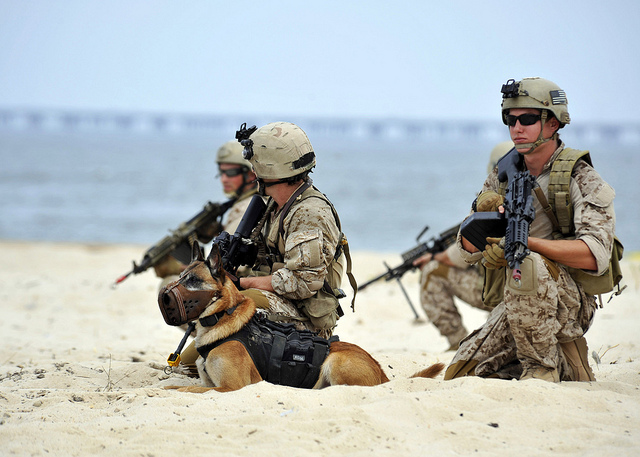
SEALs are members of the Navy who have lots of special training, so that they can go on really dangerous and difficult and sometimes secret missions.  The word SEAL stands for sea, air, and land, which are all the places that these special troops are trained to fight.


Well, back in May, when that bad man, Osama bin Laden, got killed by Navy SEALs, it turned out that one SEAL was actually a dog.  And later on, we found out that the dog was a German Shepherd named Cairo. But that's all the information I could find about the dog, which is more than almost anyone knows about the human SEALs who were in the operation.  And the reason for this was to keep Osama bin Laden's buddies from getting revenge by trying to hunt down the guys who killed him.

But anyway, I did learn some interesting things about the latest developments in doggy armor, which any military dog involved in an operation such as killing Osama bin Laden would be wearing, so I am going to tell you what I learned.

The company that makes canine armor is called K9 Storm, and they make all sorts of bulletproof vests and amazing stuff to protect dogs who do different types of work.  Some of the vests have lights, and some have cameras, and some have microphones.  The fanciest vest is called Intruder, and it costs between $20,000 and $30,000.  It has a collapsible video arm so that the dog's handler can see what the dog is seeing.  Also there is a microphone that makes it so the handler can give commands softly, and the dog can hear them through concrete walls or ship hulls or in tunnels, up to 400 yards away.


Also the vests protect the dog from gunshots and shrapnel and knife wounds.  Dogs that work as prison guards can get vests that are woven tighter, to protect against weapons such as ice picks and sharpened screwdrivers.  Also the vests are waterproof, and they are lightweight.  The average weight is between 3 and 7 pounds, depending on how many gadgets the armor has.

Just a basic vest is only $2,000 or $3,000, and every vest is made to fit a particular dog exactly right.  The vests are used by police dogs and by search-and-rescue dogs and by any other working dogs that might get hurt while they are doing their jobs.


The military knows how important war dogs are, so they don't mind spending the money to keep the dogs safe.  Gen. David Petraeus said, "The capability [the dogs] bring to the fight cannot be replicated by man or machine.  By all measures of performance, their yield outperforms any asset we have in our industry.  Our Army would be remiss if we failed to invest more in this incredibly valuable resource."

One of the things that military dogs do best is sniff out IEDs (Improvised Explosive Devices), and the Taliban has figured out that the dogs are really good at this.  So snipers often try to kill the dogs.  But wearing armor helps save the dogs' lives so they can save soldiers' lives.  And that's a very good thing.
Read More
Posted in | No comments

Wednesday, 6 July 2011

WE'RE HAVING A FLOOD!

Posted on 05:45 by Unknown
The Missouri River, which runs right through the middle of Kansas City, has been busy flooding for several weeks now.  Luckily, our house is many miles from the river, so the flood won't come here, or at least that's what Mom says, and I hope she is right.  But some people already had to move out of their houses and farms because of the flood.  Mostly these people are farther north, like in Nebraska and Iowa and North Dakota, but the flood is also happening further downstream, in the middle of Missouri.

Earlier this spring, the Mississippi River flooded, but that river seems way far away from us, so I did not pay too much attention to that flood.  But the Missouri River is right here in town, like I told you, so that makes it worth worrying about.

Sometimes floods happen because there is a ton of rain, which is what happened in 1993.  That was the last time the Missouri and Mississippi Rivers (and some other rivers, too) flooded a whole bunch.  Mom remembers this flood really well, but I don't remember it because I wasn't even born yet.

But anyway, the flood this year is not so much because of rain, but it's more because of snow melting in Montana, or some place like that.  So what happened was they got more snow than usual during the winter, and then when warm weather came, the snow melted.  And the water from the melted snow ran into all these lakes, and the lakes got really full.  So then people started opening the dams to let the lake levels go down.  Which made the river get all full and fast and floodlike.


The flood of 2011 is not supposed to be as bad as the flood of 1993 was, unless it starts raining a whole bunch, which I don't want it to do because I hate going out to pee in the rain.  But there are a bunch of places where the river broke through the levees, which are big humps of earth all along beside the river that are supposed to keep the river in its place.  The levees aren't always strong enough to do this, so they break, and then the water goes rushing into a cornfield or some other nice, flat place where water likes to go.  And it might even go into houses and barns, which is not a good thing.


Sometimes people fill bags with sand and pile them up to make a levee where there isn't one already.  If the people are lucky, the sandbags will keep the river out, but it all depends on how high the water gets.


Everybody who lives right by the river is worried about the "flood stage," which tells you whether the river is flooding or not.  For example, the flood stage in St. Joseph, which is north of here, is 17 feet.  But at 4:30 yesterday afternoon, the river was at 29.09 feet, so it was definitely flooding.  On the news last night, we saw police and reporters cruising around a neighborhood in St. Joseph in a motorboat because there is like 3 or 4 feet of water in some of the streets.


Kansas City has a the flood stage of 32 feet, and yesterday the river was 31.97 feet, so it is almost about to be considered a flood.  And in the middle of the state, at Boonville, which is close to where Mom went to college, the flood stage is 21 feet, but the river is actually 27.26 feet right now.

Meanwhile, all the rivers and streams that flow into the Missouri River are getting fuller than usual because when they get to the Missouri, there is so much water in it already that there's no room for the water from these other streams.  So that makes some of them start flooding, too.

Oh, and you can't get from Missouri to Iowa on highway I-29 anymore because part of the highway is flooded, so no one can drive there.  And also they closed some bridges from Nebraska to Iowa, and from Nebraska to Missouri, but those might be open again now.  I can't keep track of all this stuff because it's always changing!

Anyway, this whole situation is going to continue for a long time, like maybe all summer.  It's very sad for the farmers who live by the river because they won't have any crops this year.  Also maybe their houses and barns will be ruined by the water, if it gets high enough.  I don't know what farmers do with their cattle when there is a flood coming, but I hope they have some pasture on higher ground where the cows can go and not have to tread water while they are grazing.

So here's my advice for anybody who wants to go look at the river while it is flooding: "Don't get too close!"  Because if you fall in, you are sure to drown.  That's how strong and fierce the water is.  Of course, as a basenji who hates water, I wouldn't go near the river even when it wasn't flooding, but there are people and dogs who are crazy enough to want to do these things, so I'm just warning you!
Read More
Posted in | No comments

Monday, 4 July 2011

AMERICAN ENGLISH COONHOUNDS

Posted on 05:43 by Unknown
It's the 4th of July, which means it's time for me to write about a "Made in America" dog breed.  So I chose the American English Coonhound.  Except that when you look at the name of this breed, it's very confusing because you say, "Is it American or is it English?"  Well, the answer is that it's American, and I'm about to tell you why.  Also I will just mention that this is one of the three newest breeds that the AKC recognized starting on June 1.

Anyway, the American English Coonhound was developed by early American settlers who wanted sort of an all-purpose hunting hound.  So they took the English Foxhound, which was called the Virginia Hound in America, and they added in some Irish and French breeds, plus a little bloodhound.  And the result was a hound that could hunt foxes by day or raccoons by night, over really rough terrain.  Also, the coonhounds could track prey when it went up in trees, which coons often do.

American English Coonhounds are now used to hunt not just raccoons, but also opossums, cougars, deer, boars, bobcats, and bears.  These hounds can run fast, and they can also keep up a trot for several hours, if they need to.  They have really good voices, and they do what is called a "hound bawl," which tells the hunters when the dogs have treed an animal and where.

Besides doing actual hunting, the American English also competes in hunting trials and in conformation.  They have strong, muscular bodies with deep chests.  The males are 24"-26" at the withers, and the females are 23"-25".  The hounds' short coats can be lots of different colors, including red-and-white ticked, blue-and-white ticked, tri-colored with ticking, white-and-black, or red-and-white.

The fact that there is so much variety in the colors of the American English Coonhounds means they have a big gene pool, which is a good thing.  The only genetic health problem they might have is hip dysplasia.

American English Coonhounds make good family dogs because they are very sociable with people and with other dogs.  They like to live in packs, and it doesn't matter if the pack is made of humans or dogs.  They are happy and alert and confident.  Because of their loud hound voices, they can be good watch dogs, but it's probably not a good idea to have them in an apartment or other places with close neighbors.  They need quite a bit of exercise because they are very energetic dogs who were bred to do a job.  But they also really like to curl up on a cushy sofa or bed.

So that's today's blog entry about an all-American dog breed.  And now I will say, "Happy Fourth!"  And I hope your dogs don't get too scared when all the horrible, noisy fireworks are going off!
Read More
Posted in | No comments

Sunday, 3 July 2011

President Harding and Laddie Boy

Posted on 05:39 by Unknown

It's almost Independence Day, so I thought that writing about another First Dog would be a nice, patriotic way to celebrate the holiday.  And when I learned about Laddie Boy, who was probably the most famous and popular First Dog ever, I knew that he was the one I should write about.

But to begin with, I will tell you a little bit about Laddie Boy's dad, who was Warren Gamaliel Harding.  He was born in Blooming Grove, Ohio, on November 2, 1865, and he was the oldest of 8 children.  Later, the family moved to Caledonia, Ohio, and Warren Harding's father bought the local newspaper.  At the age of 10, Warren began learning all about his father's business.  When he went to college, he learned even more about journalism, and he also learned a lot about public speaking.  In 1882, at the age of 17, he graduated from Ohio Central College with a Bachelor of Science degree.


After college, Mr. Harding moved to Marion, Ohio, and he ran the Marion Daily Star.  Later on, he served in the Ohio Senate, as Lieutenant Governor of Ohio, and as a U.S. Senator.  In 1920, the Republican Party nominated him to run for president.  He was friendly, conservative, and got along well with everybody.  He promised a return to "normalcy" after World War I.  Lots of people voted for him, so he was elected by a landslide.

The press really liked President Harding because he was a newspaperman himself.  He let them ask lots of questions, was honest with them, and even admitted he wasn't perfect.  But Congress didn't like him as much, and they didn't give him a "honeymoon," like they usually give to new presidents.


Laddie Boy came to the White House on March 5, 1921, which was the day after President Harding took office.  The new First Dog was an Airedale terrier, and he was 7 months old.  He had been born on July 26, 1920 at Caswell Kennels in Toledo, Ohio.  The president told his staff to let him know when the dog arrived, so they did, even though there was a cabinet meeting going on.  President Harding was so happy to get Laddie Boy that he brought him right into the meeting.  And ever after that, Laddie Boy went to most cabinet meetings, where he had his very own hand-carved chair to sit on.

Oh Boy and Laddie Boy
with caretaker Willie Jackson
For a little while, there were two First Dogs, because Mrs. Harding got an English bulldog as a gift.  His name was Oh Boy, but sadly, he was not very healthy, and he died not too long after he arrived at the White House.

First Dog and First Lady
But President and Mrs. Harding still had Laddie Boy, and they treated him like the son that they didn't have.  They let him run around all over the White House and greet visiting dignitaries on the front steps.  He got to beg for food from guests and play with children.  When the president went out on the lawn to hit some golf balls, Laddie Boy retrieved them.  Also he would bring the president his newspaper every morning while he was eating breakfast.  And the First Lady often let Laddie Boy make an appearance at fundraising events.

Laddie Boy okays his official portrait
The press especially liked Laddie Boy, and they wrote about him almost every day.  Sometimes they made up interviews with him to print in their papers.  This is how Laddie Boy got to be so extremely popular with everybody in the country.  Historian Helena Pycior said that he "was the first of the modern First Dogs . . . helping to further one of the Hardings' special causes -- animal welfare."  Of course, the Airedale breed got to be more popular, too, and many people wanted an Airedale of their very own.

A birthday cake made of dog treats!
When it was Laddie Boy's birthday, the White House would have a party and invite neighborhood dogs to come over and share a big cake made out of dog biscuits.  The First Dog hosted the Easter Egg Roll on the White House lawn in 1922 and 1923.  And he rode on his very own float in a Humane Society parade.

Unfortunately, President Harding did not have a very fun time in the White House because there were a bunch of scandals and stuff going on.  He sort of tried to use Laddie Boy to distract people from thinking about the scandals, but this did not work all that well.  One time the president said, "I am not fit for this office and should never have been here."  Many people think of the Harding presidency as a failure, but he did do some good things, such as reducing income tax, federal spending, and unemployment.  Also he managed to make more peaceful relations with Germany, Japan, and Central America.


But the stress of his office was not good for President Harding's health, so in June of 1923, he and Mrs. Harding left Washington on a trip all the way across the country.  They even went to Alaska, which made Mr. Harding the first president to go there.  And wherever he went, he gave talks to explain his policies.  But as the trip went along, the president started feeling worse and worse.  Finally, in San Francisco, he died in his hotel room.  Probably he died from heart failure or maybe from a stroke.

Waiting for Dad to come home from his trip
Laddie Boy did not go on this trip, but some people said he could feel that something was wrong, and he howled for three days before President Harding died.  I don't know if this is a true story or not, but I know that it was very sad for Laddie Boy to lose his dad.

President Harding's funeral procession
When Mrs. Harding was getting ready to move out of the White House, she gave Laddie Boy to Harry Barker, the Secret Service agent who had been assigned to protect her, and who had been like a son to her.  Mr. Barker was transferred to the agency's Boston office, so Laddie Boy went to live with him and his wife in Newtonville, Massachusetts.

Meanwhile, 19,000 members of the Newsboys Association donated pennies to be melted down for making a life-sized statue of Laddie Boy for Mrs. Harding.  The sculpture was made by Bashka Paeff, but unfortunately, she didn't get it finished before Mrs. Harding died in 1924.  The statue of Laddie Boy is in the Smithsonian collection, but it is not on display right now.

Laddie Boy's statue at the Smithsonian
and an unidentified man
Laddie Boy himself died of old age on January 22, 1929, in the arms of Mrs. Barker.  He was buried somewhere in Newtonville.  And that's all I know about Laddie Boy, except that he was a good dog, and he had a long, good life.
Read More
Posted in | No comments

Friday, 1 July 2011

A Dog Named Ricochet

Posted on 05:26 by Unknown
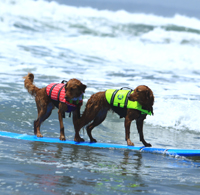
You might have already heard of Ricochet because she was in a video that tons of people saw on YouTube.  Ricochet is a golden retriever, and she was born on January 25, 2008 in a service dog program called Puppy Prodigies.  There were 10 puppies in her litter, and she was puppy number 9.  When Ricochet was only 13 days old, she already started her training!  She learned to do all sorts of useful things, like open doors and turn on lights and pick up things for people who need help doing this.  And when she was 8 weeks old, Ricochet also started learning to surf, by balancing on a surfboard in a wading pool.

Ricochet grew and grew, and she got lots of training, but there was a problem, which was that she really, really liked to chase birds and squirrels and all kinds of critters like that.  Of course, this is perfectly normal dog behavior, and I don't think there is anything wrong with it, personally.  But if a dog is a service dog, that dog is supposed to stay focused on helping its person, instead of getting distracted and running off after rabbits or whatever.

So Ricochet's trainer got very sad because she saw that Ricochet couldn't really be a good service dog.  But about this same time, Ricochet got invited to compete in a doggy surfing event.  So she went there and competed, and she won 3rd place.  After that, the people at Puppy Prodigies decided maybe Ricochet could be a SURFice dog instead of a service dog.

This was a whole new kind of program that hadn't been done before, but Ricochet was the perfect dog to do it because she had all that service-dog training, plus she was also good at surfing.  So she started working with disabled people to help them go surfing.  And also she did a whole bunch of fundraising for lots of different causes.

One of Ricochet's first causes that she helped with was raising money for a boy named Patrick Ivison.  Patrick is 15 years old, and he has been using a wheelchair most of his life.  When he was only 14 months old, he and his mom were walking behind a parked car, and the driver backed over Patrick and he became a quadriplegic.  Then when Patrick was 10, he started doing a special kind of therapy that could eventually help him walk.  This therapy has already made it so that Patrick can pick things up with his hands, which he couldn't do before.

But the therapy is really expensive, like $30,000 a year, and Ricochet is helping raise the money that Patrick needs to get the therapy.  Also Patrick and Ricochet go surfing together, riding on the same surfboard, and they have lots of fun doing that.

Ricochet has her very own website, where you can read all about her and all the causes she has helped with.  Plus you can see several videos of her surfing with Patrick and other people.  Ricochet has won a ton of awards, which you can read about on her site.  Some of the causes she has helped raise money for are:  canine cancer, breast cancer, arthritis, autism, spinal cord injuries, animal rescue, and several groups that help disabled people get to go surfing.

Anyway, Ricochet's story is very heartwarming and inspiring.  But I have to tell you that I don't think there is enough inspiration in the whole wide world to ever get me on a surfboard.  There is way too much chance of getting wet out there in the ocean!
Read More
Posted in | No comments
Newer Posts Older Posts Home
Subscribe to: Posts (Atom)

Popular Posts

  • FATHER TIME
    Father Time is an old guy who usually shows up about this time of year, and sometimes you see him hanging out with Baby New Year.  Father Ti...
  • AN OLD, ABANDONED SCHOOL
    Not too long ago, Mom went to a part of town called Blue Summit, and she had never been there before, so she drove around some, just to see ...
  • OLD TIME FARM SHEPHERD DOGS
    Today is the Fourth of July, which means that it's time for me to write a nice, patriotic blog entry about some breed of dog that was in...
  • THE BURY HUNT
    Maybe you will sort of remember that Mom bought four placemats at an estate sale several months ago, and these placemats had pictures of Eng...
  • CERBERUS
    There's a dog in Greek mythology that is very famous, and his name is Cerberus.  This dog was owned by Hades, the God of the Underworld,...
  • WILD AFRICAN DOGS
    There are lots of different names for these dogs, and here are some of them:  African Wild Dog,  African Hunting Dog, Cape Hunting Dog, Pain...
  • HOW MANY CATS DOES IT TAKE TO MAKE A CLOWDER?
    Well, first of all, I would like to thank everybody who said they liked my "Ode to Summer" poem that I posted yesterday.  I don...
  • OPRAH WINFREY'S DOGS
    Oprah Winfrey is very famous, so that means most everybody has heard of her, and I don't have to explain who she is.  The way she got fa...
  • A Dog Named Old Yeller
    When Mom was a little girl, her favorite book was Old Yeller , by Fred Gipson.  She loved that book a whole bunch, even though it made her c...
  • SILVER FOX RABBITS
    This animal has a very confusing name because first you think it is a fox, but then you find out it is a rabbit.  And to make things more co...

Blog Archive

  • ▼  2013 (92)
    • ▼  August (5)
      • THE CACTUS SHOW
      • PANLEUKOPENIA
      • ADVENTURES WHILE WALKING, by Dorrie the Chihuahua
      • SAD AND GLAD NEWS ABOUT OUR KITTENS
      • THE BARLOW ROAD
    • ►  July (11)
    • ►  June (10)
    • ►  May (12)
    • ►  April (14)
    • ►  March (14)
    • ►  February (14)
    • ►  January (12)
  • ►  2012 (177)
    • ►  December (13)
    • ►  November (12)
    • ►  October (14)
    • ►  September (13)
    • ►  August (12)
    • ►  July (14)
    • ►  June (14)
    • ►  May (17)
    • ►  April (16)
    • ►  March (17)
    • ►  February (17)
    • ►  January (18)
  • ►  2011 (231)
    • ►  December (19)
    • ►  November (19)
    • ►  October (21)
    • ►  September (20)
    • ►  August (20)
    • ►  July (22)
    • ►  June (20)
    • ►  May (22)
    • ►  April (21)
    • ►  March (22)
    • ►  February (20)
    • ►  January (5)
Powered by Blogger.