thePiperSHIHTZU

  • Subscribe to our RSS feed.
  • Twitter
  • StumbleUpon
  • Reddit
  • Facebook
  • Digg

Thursday, 13 September 2012

THE TOTAL CUTENESS OF OUR KITTENS

Posted on 06:28 by Unknown
Mom thinks our new foster kittens are really cute, just like she thinks all of our foster kittens are cute.  And whenever Mom thinks anything is cute, she just can't help herself -- she starts taking bunches of pictures with her camera.  So now we have a boatload of photos of our foster kittens, and the only way to make sure the photos don't go to waste is for me to put some of them in my blog.  Or at least that's what Mom says, so anyway here goes.

In this first picture, you can see Mickie, Macie, and Moxie.


And here's a photo of "Mother Jason," as we call him, because he loves the kittens and likes to take care of them.  Jason is the only one besides Mom who goes in the kitten room.  Jason licks the kittens clean and plays with them and poops in their litter box to show them how it's done.  Also he finishes up their food if they don't eat it all.  The kittens snuggle with him and try to find the milk spigots, but so far, they haven't had any luck.


Sometimes little Mickie needs special attention, because she is still too young to clean herself up very well.  Mom does this for her part of the time, but other times she lets Jason do it.


When the kittens eat, they are very, very messy.  They just wade right into the middle of their food dish, and they get cat food all over their feet and tummies and noses.  I think this is silly, but Mom says that I probably ate the same way when I was a puppy.  I find this hard to believe, but sometimes it's not worth the bother to argue with Mom.


Here's Macie after she just finished eating and still has food on her nose and probably on her feet, too.


And this is Macie sleeping on a toy.  It's really a dog toy, but Mom won't let us dogs have it because she says we would just tear it up.  


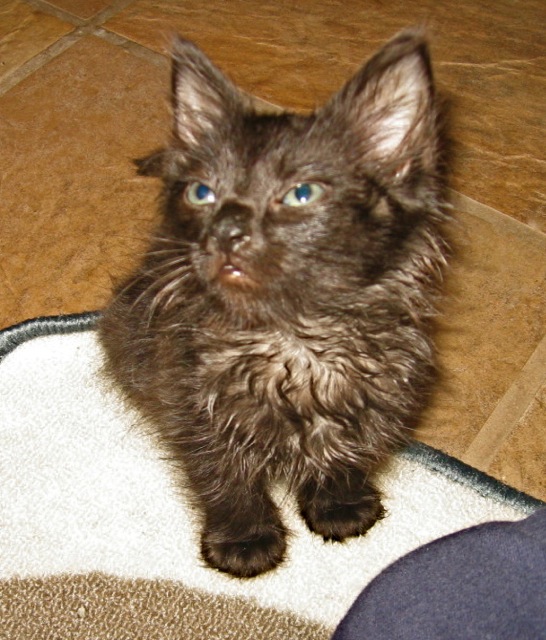
This is Morgan.


And here's Morgan playing with Moxie.


At bedtime, the kittens all go in a nice crate that Mom fixed up for them to sleep in with a bunch of cushy blankets and also a heated disk thing under their bed to make sure they stay warm.


"I won't go to bed!" says Morgan.  "Just try to make me!"


Mingo is a very handsome dude.


Little Mickie feels much better now that she got rid of all those tapeworms.  She is eating real food, just like the big kittens.  She is playing and tottering around the room really fast on her short little legs.  She even purrs now, but not as much as the big kittens.  It's hard to believe she is 5 weeks old already because she is still so little.


We are hoping that Mickie will be healthy now and will grow up to be an adult cat.  She might always be a small kitty, but that's okay.  At least it's a lot better than dying at a very young age!


Read More
Posted in | No comments

Monday, 10 September 2012

CELTIC DRAGONS

Posted on 06:31 by Unknown
Maybe you remember that it is still the Year of the Dragon, because it still is.  The sad thing is that I haven't got to write very much about dragons lately because my Chief Research Assistant (a.k.a. Mom) has been so busy.  But today I am going to tell you about Celtic dragons.


It turns out that the Celts were people who lived in a bunch of places in Europe, and not just in the British Isles, like I thought.  They were one of many European cultures that believed in dragons and in their special powers.  Probably the Asians were the first ones to invent the idea of dragons, but then that idea traveled to Europe, maybe through Iran.

The English word dragon came from the Greek word drakon, which has some meanings like "sharp-sighted one," "one with a deadly glance," and "serpent."  The Greek word was adopted into Latin as draco, which came to mean "a giant snake."  So the European dragon, especially for the Celts, was an Earth Serpent, and it represented all the elemental power of the earth.


The ancient Druids, who were the priests of the Celtic people, believed that the earth was like the body of a dragon, and they built sacred stone circles on the "power nodes" of the dragon's body.  Wherever a dragon had walked or had its lair was a place with lots of sacred energy.  The Druids looked for mystic lines that were called "The Path of the Dragon" or "ley lines."  When the priests found one of these lines, they told the people to build their homes and temples along it so that they could take advantage of the earth's energies.

Stone Circle at Callanish, Isle of Lewis, Scotland

In this way, dragons had the power to connect humans to the earth's magnetism and healing waters.  Also, dragons were the guardians of wisdom and knowledge.  If you see some Celtic artwork that shows a dragon swallowing its tail, this shows a circle that goes on and on, and it is the symbol of eternal life.

Cari Buziak, artist


Celtic people revered dragons as if they were gods because dragons could bring the forces of heaven and earth together.  Also they guarded the gates to the Heavens and to the Underworld.  They were guardian spirits who protected all living things, and that made them one of the most powerful of all Celtic symbols.

The dragons of European folklore looked a lot like serpents.  They had wings like bats and legs like lizards.  Usually there were two pairs of legs, but some dragons didn't have have any front legs, and these dragons were called wyverns.

1958 Welsh Stamp

The Welsh people had a more positive view of dragons than most other Europeans did, and that's why they put a red one on the Welsh flag.  Other traditions said dragons were evil, and that they breathed fire, and that they usually had a bunch of treasure hidden someplace in a cave.  These were the kinds of dragons that people like Beowulf and St. George had to go out and slay.  Which was very dangerous and also seems like it would be a huge bother, but I guess somebody had to do it!


The Flag of Wales


Read More
Posted in | No comments

Saturday, 8 September 2012

AN ALLIGATOR IN KANSAS!

Posted on 05:40 by Unknown
Last week the 1,068 or so people who live in Caldwell, Kansas were shocked to learn that a huge, scary, vicious alligator was roaming their streets, looking for small children to eat.  If this happened in Florida, it would not have been such a big deal because people in Florida are used to finding alligators in their gardens and bathtubs and all sorts of places like that.  But in Kansas, people mostly only see wild bison out running around, not alligators.


You may be wondering where the town of Caldwell is, so I will tell you.  It is in the south part of Kansas, almost in Oklahoma.  It turns out that towns like Caldwell and Abilene were on an old-time road called The Chisholm Trail, and ranchers from Texas used to drive their longhorn cattle up to these towns so the cattle could get shipped in trains to the east part of the U.S., where beef was what was for dinner.


Anyway, the alligator thing happened because a man named James Rowley had a young pet gator that he kept in his basement.  Except that sometimes the alligator got to spend time in an alligator habitat in the back yard.  There was a pond in this habitat, and Mr. Rowley would feed goldfish to the alligator while he swam there.   But what happened last week was that the pond overflowed, and the alligator was able to get to the top and then just walk out of the habitat.

Soon people started seeing an alligator walking around town, like for instance at the corner of 2nd and Main Streets. Every time somebody told the story of the ferocious alligator, he got to be bigger.  First they said he was 3 or 4 feet long, and pretty soon he was 4-1/2 or 5 feet.

The kids at the elementary school near where the gator lived were not allowed outside at recess, and they had to call their parents to come pick them up after school instead of walking home.  At the high school, football practice was cancelled.  Everyone was afraid of being eaten alive by the alligator.

Meanwhile, a game warden from Kansas Wildlife and Parks came to Caldwell and tried to figure out how to deal with the situation.  He called officials in Florida to find out how to capture an alligator.  Also he asked Mr. Rowley how he got this animal in the first place because maybe it was illegal for him to have it.  But it turned out that Mr. Rowley had bought the alligator legally in 2010 in Derby, KS.  Which is probably the first place most people would think to go if they wanted to buy an alligator as a pet.  Mr. Rowley had the proper permit to own his alligator, and he had not crossed any state lines with it, so everything was according to the law, except for the fact that the alligator was out exploring the town.

A bunch of people started looking for the gator, and finally two boys saw him under some boards at the  Home Lumber Supply Co.  He was captured and put in a dog crate and taken to the police station.  It turned out that the alligator was only 38" long.  "He's feisty," said Mr. Stout, the game warden.  "He keeps hissing at us.  It's pretty interesting."  The hissing made the police nervous, so the taped the gator's mouth shut.

Photo by DeeAnna Stout; KSN.com

Since Mr. Rowley got his alligator legally, he is not in any trouble with the state of Kansas.  But the town of Caldwell might decide to punish him somehow.  Mr. Rowley has his alligator back now, and it turns out that his name is Munchie Mouth.  Which is a pretty good name for an alligator, if you ask me. Anyway, Mr. Rowley thinks that people got upset "about a lot of nothing."  He says that his pet is "tiny" and that "He doesn't even eat anything other than some lunch meat."  He also says, "Munchie Mouth couldn't really hurt anybody at this point, but it caused quite a thing here in town."


Well, if you want my opinion, I think a 38" alligator is not "tiny," and I would not personally want to have anything to do with him because he might mistake me for some lunch meat.  I just keep thinking about that Fatal Attraction show on Animal Planet, where people get these dangerous wild animals when they are babies, and then the animals grow up and bite somebody's leg off or kill them or whatever.

I told Mom I never want to go live in Caldwell, KS, and also I never want us to have an alligator for a pet.  And for once, Mom totally agreed with me!


Here's an early photo of Caldwell, showing a herd of covered wagons being driven into town.  I don't know where they are going, but maybe it's to California or Oregon or some other fun place.  You can see by looking at this photo that there were no alligators in Caldwell back in those days.
Read More
Posted in | No comments

Friday, 7 September 2012

MICKEY HAS TAPEWORMS!

Posted on 06:49 by Unknown
Well, guess what!  Our little Mickey foster kitten has TAPEWORMS!  And on Wednesday, a really, really long one came right out of Mickey's butt!  Ick!  Mom captured the tapeworm and put it in a little container with some water and took a picture.  And then she took the tapeworm with her when she went to the shelter to have Dr. Regan look at the kittens.


Everyone was totally grossed out by the tapeworm because it was very long, and it looked kind of like spaghetti or maybe a rice noodle.  One other time, Mom found a piece of tapeworm coming out of Mickey's butt, and it was about an inch long.  Dr. Regan said that Mickey could not possibly have a tapeworm because the only way you can get tapeworms is by eating a flea that has tapeworm eggs in it, and Mickey was too young to be grooming himself and swallowing fleas.  Dr. Regan said maybe the worm Mom saw was a roundworm, and Mom decided that Dr. Regan was right.

But this time Mom was very sure that the worm she saw was a tapeworm because it was flat and had segments.  Then when Dr. Regan saw the worm, she agreed that it was most definitely a tapeworm.  But she said she had never seen one in a kitten as young as Mickey.


Oh, and guess what else!  It turns out that our little boy kitten Mickey is really a GIRL kitten!  So Mickey is now Mickie.  Of course, I knew all along that Mickie was a girl because she smelled like a girl, but Mom is only a silly human, so she didn't figure this out.  Actually, when the lady first brought Mickie to the shelter, Aunt Tania and Aunt Nancy thought she was a girl.  Then after a week or so, they decided maybe some boy parts were showing up, so they changed Mickie to Mickey.  But now those humans finally know that Mickie was really Mickie all along, and she is a girl, just like me.

Okay, but getting back to tapeworms, the kind you get by eating a flea are the Dipylidium caninum species.  There is another kind of tapeworm you can get by eating a mouse or rat.  Dr. Regan thinks the only way Mickie could have got her tapeworm was by swallowing a flea while she was nursing on her mama.  Because her mama was a feral cat and was probably covered with fleas.

Here's the way that fleas get tapeworms in them:  first a dog or cat who has tapeworms poops out some little capsule things that have a bunch of worm eggs in them.  After that, flea larvae eat the eggs, and then the grown-up flea has the eggs inside it.  And when an animal swallows a flea while chewing on an itchy flea bite, the tapeworm eggs go down inside the intestines, which is just the homey kind of place they like to hatch out and grow to be nice and long, and then they make more eggs.


Anyway, Mickie is so little that they don't even make doses of tapeworm dewormer that small.  So Dr. Regan had to just guess how much to give her.  So now Mickie has had some medicine, and maybe it will kill off her tapeworms, which were probably making her feel not so good anyway.  Plus the tapeworms were keeping her from getting all the good nutritious stuff from her food.


Another thing Dr. Regan said was that Mickie might be older than she looks because she might not be growing as fast and as big as she is supposed to.  This is what's called Failure to Thrive, and it makes a kitten or puppy kind of puny.

When Mom brought the kittens back home from the shelter, she picked Mickie up to feed her, and there was another tapeworm crawling out of her!  This one was only about 3" long, but Mom took a picture of it, too.  She put a quarter in the picture so that you can tell what size the tapeworm is.  I think maybe Mom is getting a little carried away taking pictures of yucky things like tapeworms.  But that is just my opinion, which I am happy to give, even if nobody asked for it.


Mom worries a lot about poor little Mickie because Mickie's kitty mom abandoned her, so that might mean the kitty mom knew something was wrong with Mickie, even if humans can't tell what it is.  This is what happened with Carson, our first foster kitten that we got last year.  Maybe you will remember that Carson turned out to be blind and also he had some other problems that made him walk in circles all the time.  And sadly, that is why he had to be put to sleep.

So we keep getting reminded of Carson when we look at Mickie, because even though she can see and walk better than Carson could, she might have something else wrong with her that will make her die at a young age.  Which would be a horrible, tragic thing that we don't want to happen.
Read More
Posted in | No comments

Wednesday, 5 September 2012

GUIDE DOGS

Posted on 06:54 by Unknown
September is National Guide Dog Month, at least in some states, which is why I decided to write about these Very Important Dogs.  Also we just had Labor Day, and guide dogs are working dogs, so that is another good reason to talk about them.

Anyway, most people know that guide dogs are trained to help blind people get safely to the places they want to go without having to depend on somebody else.  You might have heard guide dogs called "seeing eye dogs," and this is because the oldest existing guide dog school in the world is called The Seeing Eye, Inc.  It is located in Morristown, NJ.  The term Seeing Eye® dog is actually a registered trademark, and "guide dog" is the generic term.


Way back in history, people had already started figuring out that dogs could lead blind people around.  The first time this was mentioned in writing was in the mid-16th century.  Later on, during World War I, Germany built the first schools to train guide dogs for soldiers who got blinded in battle.  In the U.S., the Seeing Eye® School was established in 1929 in Nashville, and then it moved to Morristown in 1931.  Great Britain started training guide dogs in 1934 at The Guide Dogs for the Blind Association.  Now lots of countries have places where guide dogs are trained.


The breeds that are mostly used as guide dogs are Golden Retrievers, Labradors, and German Shepherds.  That's because these breeds are generally intelligent, friendly, easy to train, and they have the stamina they need to do the job.  Guide dog schools usually breed their own dogs so that they will get the qualities they want in a service dog.

When the puppies are about 12 weeks old, they go to live with "puppy raisers," who are people who volunteer to train and socialize the puppy for a year or 18 months.  The puppy raisers take the pups to all kinds of new places, where they can meet lots of people and hear lots of strange sounds and see lots of different things.  Usually, the puppy wears a vest so that everybody knows it is in training to do important work.  And with its vest on, the puppy can go into all sorts of places that most dogs don't get to go into, such as churches and restaurants and buses.  Also, the puppy learns basic obedience commands.


After the puppy is old enough, the people who raised it have to give it back to the guide dog school, which can be very sad if they are attached to the puppy.  But they know it is for a good cause, and usually they get another pup to raise after that.

Back at the school, trainers evaluate each dog for a bunch of important things such as intelligence, willingness to learn, being able to concentrate, paying attention to touch and sound, good memory, and excellent health.  But even if the dog has all these qualities, he might still get weeded out if he is aggressive, nervous, or reactive with cats or other dogs.


So only the dogs who are the very most suited for the job get to be guide dogs.  For example, at one school, Guiding Eyes for the Blind, just the top 50% of dogs stay and get trained to be guide dogs.  If they don't seem like they would make good guide dogs, they might end up as a different type of service dog or doing some other job such as tracking.  Every year this school places about 400 puppies with puppy raisers so that they can end up with 200 or so to train as guide dogs.

The dogs that don't make it into the training program are placed in pet homes.  First the puppy-raiser family gets the chance to adopt them, but if they don't choose to do that, other people can adopt the dogs.


It takes about 4 or 5 months to train a guide dog, and the reason it takes that long is because they have a lot of stuff to learn.  Here are some of the things these dogs are trained to do:

1)  Keep walking in a straight path without getting distracted by interesting smells, people, and animals.
2)  Walk at a steady pace, on the left side of the handler and just a little bit ahead.
3)  Stop at all curbs and don't go on until told to.
4)  Avoid anything that would be an obstacle for the handler, such as narrow places and low stuff overhead.
5)  Follow commands to go forward, right, or left.
6)  Stop at the bottom or top of stairs and wait until told to go on.
7)  At an elevator, take the handler to where the buttons are.
8)  Lie quietly while the handler is sitting down.
9)  Help the handler get on public transportation, like for example buses and planes and subways.
10)  Know when to disobey a command, if it would put the handler in danger to obey it.


When guide dogs and their handlers get to know each other well, the dog learns what the person's usual schedule is.  So maybe all the person has to say would be "to the office," and the dog could take the person all the way there.  Also, guide dogs are trained specifically for a male or female handler, so if the handler needs to go to the restroom, the dog can find the correct one by smell.  Because dogs have really good noses, as I have mentioned more than once.


Guide dogs wear special harnesses while they are working, and you should not bother a dog while it is on the job.  If you really, really want to pet the dog, make sure you ask the handler first.  When the dog is "off duty," the harness is taken off, and then the dog can run around and just act like a regular dog.

Blind people can usually get a guide dog for free, but this means that the schools where the dogs are trained have to cover the costs through donations from nice, generous people.  When a blind person is approved to get a dog, the person goes to the school where the dog is and stays for about a month to learn how to work with the dog.  The people at the school try to make a good match of personalities between the blind person and the dog.


Guide dogs usually retire at age 8 or 10, before their health starts to fail.  The handler will get a new dog at that time.  If he wants to, the handler can keep the retired dog as a pet, but if that is not possible, the school will find someone else to adopt it.  Sometimes there is even a waiting list of people who want to adopt retired guide dogs because they are so mellow and well-trained.

I don't think basenjis have ever been used as guide dogs.  Personally, I would not want to be one.  It seems like way too much work, and also if I was out with my person, and I saw a squirrel, I would be gone in a flash!
Read More
Posted in | No comments

Monday, 3 September 2012

MEET THE "M" KITTENS!

Posted on 06:52 by Unknown
Well, guess what!  We have a whole new fresh batch of foster kittens!  We've had them for a whole week now, so maybe they aren't totally new anymore, but they're still new enough.

The foster kittens we used to have -- Waverly, Willis, Wyatt, and Waldo -- all got adopted.  Willis and Waldo got adopted together by a lady who has two dogs.  And then a week later, Waverly and Wyatt got adopted together, but Mom wasn't there when the adoption happened at PetSmart, so she doesn't know who adopted them.  She just knows that when she went to pick them up, they had just got adopted, and so she felt kind of sad to come home with no kittens.

But now we have FIVE new kittens, and we are not sad anymore!  The new kittens all have names that start with "M."  Four of them are littermates, and the fifth one is younger, and he isn't related to the other ones, but he doesn't know that.


Moxie
Now I will tell you the story of these kittens.  First of all, a man brought a little Siamese-mix kitten to the shelter.  He found the kitten alone in some bushes near his house.  So one of the vet techs at the shelter took the kitten home and fed her out of a bottle, and named her Moxie.

Then a lady brought in a feral mama cat and her four kittens.  The lady had been feeding these cats, and she caught them in a trap.  So Aunt Tania took them home with her, but one of the kittens was puny, and it died.  Meanwhile, Aunt Tania and the other people at the shelter figured out that Moxie was really part of this same litter, because the lady who brought the litter in lived nextdoor to the man who brought Moxie in.


Macie
Aunt Tania kept the mama cat and her kittens at her house, but the mama cat was not wanting to take care of the kittens, so Aunt Tania had to help feed them and then get them weaned so that they would start eating real food and not just milk.

I don't know exactly when all this happened, but I do know that on August 21st, a lady brought in a tiny gray kitten who was about 2 weeks old.  This kitten got abandoned by his mama.  The lady knew for sure that that is what happened because she had been feeding some feral cats, and one had kittens, but then she abandoned one.  Which probably meant that it was sick or something.


Mickey
So this kitten got named Mickey.  He had bad eye-goopy stuff and probably a respiratory infection, so he got some medicine, and Aunt Tania took him home and fed him with a bottle.  And after a week, he was doing much better.

Okay, well, all of that happened, and then last Monday, Mom was ready to foster some more kittens.  She didn't have to take all five of the kittens, but she decided to do it because she is sort of crazy like that.  The four littermates were about five weeks old then.  Mickey and Moxie already had names, and there was also another Siamese-mix girl named Macie.  She was the most puny kitten after the one who died, so Aunt Tania was taking special care of her and put her in a cage with Mickey, so he wouldn't be lonely.


Mingo
The other two kittens are boys, and they didn't have names yet, so Mom got to name them.  One is a Siamese mix, and the other is black, with kind of long, soft hair.  Mom named the first one Mingo, and she named the black one Morgan.


Morgan
The kittens live in the room where the "W" kittens used to live, but they are staying in crates right now, and not running around loose most of the time.  Mom keeps the bottom half of the doors closed, so we dogs can't go in the room, which is sad because it smells like we could eat some really yummy kitten poop if we could just get in there.  Jason goes in all the time, and he plays with the kittens a little, but they are still pretty small, and they don't exactly know how to play yet.


Mickey
Mom has to feed Mickey every 3 or 4 hours.  He has a very loud voice, and he cries a lot when he is hungry.  Mom doesn't get up in the night to feed him because she is too lazy.  He can mostly get through the night without crying, so that's good.  Mom wants him to start eating real cat food instead of just milk, so he can grow up to be a big, strong kitten.  Right now he is very funny-looking because his head is way too big for the rest of him, but Mom says he will probably grow into it.  I think he just looks like a little gray mouse, which might be how he got the name Mickey.
Read More
Posted in | No comments

Friday, 31 August 2012

SOME WORDS AND A PHRASE

Posted on 06:33 by Unknown
KICK THE BUCKET

As most people know, this phrase means "to die."  It already meant that all the way back in 1785, when it was published in the Dictionary of the Vulgar Tongue.  Nobody really knows where the phrase came from, but of course that doesn't keep people from making up theories.  So here are some of those theories:

Theory #1:  People "kick the bucket" out from under themselves if they are committing suicide by hanging.  Or if one person is hanging another person, they might kick the bucket out from under them.  But this doesn't seem like a very good theory because if you were only standing on a bucket, you wouldn't fall very far, but I guess if the rope was short enough, and your feet didn't touch the floor, you would still strangle to death.

Theory #2:  In the old days, at Catholic wakes, there was a bucket sitting at the feet of the dead person, and this bucket had holy water in it.  But nobody kicked this bucket.  They just sprinkled the water on the body when they came to pray.

Theory #3:  The best theory is that back in the 16th century, the word bucket also meant a beam or yoke that was used to hang or carry things.  The French word trébuchet, which means "a balance," is likely where the English word bucket came from.  When animals such as pigs were being killed, they were hung up by their feet, and then their throats got slit.  While they were dying, they probably kicked the beam they were tied to, and so they "kicked the bucket."  I don't like to think about this, but I'm just telling you, in the interest of linguistics, where this phrase might have come from.


DESQUAMATE

If you get a sunburn, your skin might desquamate afterwards.  This is a medical word, and it means "to come off in scales," "to shed," or "to peel off."  It seems to always be used to talk about skin, and never about anything else such as onion peels or fish scales.  The word came into the English language in the 18th century.  It was a combination of the Latin desquamare which meant "to scale off" with squama which meant "a scale."


PUNCTILIOUS

A person who is punctilious likes to make sure that everything is done exactly right, even the smallest details.  I guess this might be important if you are having a ceremony or a formal dinner or something, but it just seems kind of anal to me!


HOSTLER or OSTLER

Back in the old days, if you stopped at an inn for the night, the hostler was the man who took care of your horses.  The word is from Middle English, about 1350-1400, and it was a variation of hosteler.

That meaning is pretty much archaic, but the job of hostler got updated, and now it is somebody who takes care of trains, buses, and other such vehicles after their regular runs.  The hostler moves the vehicles and large equipment, and does maintenance work on it.


HIPPOPOTOMONSTROSESQUIPPEDALIOPHOBIA

I am not making this up.  It really is a word, and what it means is "fear of long words."  Hahahaha!  But if you are a little scared by its length, you can just say sesquippedaliophobia, and that means the exact same thing!

Read More
Posted in | No comments
Newer Posts Older Posts Home
View mobile version
Subscribe to: Posts (Atom)

Popular Posts

  • FATHER TIME
    Father Time is an old guy who usually shows up about this time of year, and sometimes you see him hanging out with Baby New Year.  Father Ti...
  • AN OLD, ABANDONED SCHOOL
    Not too long ago, Mom went to a part of town called Blue Summit, and she had never been there before, so she drove around some, just to see ...
  • OLD TIME FARM SHEPHERD DOGS
    Today is the Fourth of July, which means that it's time for me to write a nice, patriotic blog entry about some breed of dog that was in...
  • HOW MANY CATS DOES IT TAKE TO MAKE A CLOWDER?
    Well, first of all, I would like to thank everybody who said they liked my "Ode to Summer" poem that I posted yesterday.  I don...
  • THE BURY HUNT
    Maybe you will sort of remember that Mom bought four placemats at an estate sale several months ago, and these placemats had pictures of Eng...
  • CERBERUS
    There's a dog in Greek mythology that is very famous, and his name is Cerberus.  This dog was owned by Hades, the God of the Underworld,...
  • WILD AFRICAN DOGS
    There are lots of different names for these dogs, and here are some of them:  African Wild Dog,  African Hunting Dog, Cape Hunting Dog, Pain...
  • A Dog Named Old Yeller
    When Mom was a little girl, her favorite book was Old Yeller , by Fred Gipson.  She loved that book a whole bunch, even though it made her c...
  • THE SHAPES OF DOGGY EARS
    If you have looked at very many dogs, which I hope you have, you may have noticed that their ears come in lots of different shapes and sizes...
  • OPRAH WINFREY'S DOGS
    Oprah Winfrey is very famous, so that means most everybody has heard of her, and I don't have to explain who she is.  The way she got fa...

Blog Archive

  • ▼  2013 (92)
    • ▼  August (5)
      • THE CACTUS SHOW
      • PANLEUKOPENIA
      • ADVENTURES WHILE WALKING, by Dorrie the Chihuahua
      • SAD AND GLAD NEWS ABOUT OUR KITTENS
      • THE BARLOW ROAD
    • ►  July (11)
    • ►  June (10)
    • ►  May (12)
    • ►  April (14)
    • ►  March (14)
    • ►  February (14)
    • ►  January (12)
  • ►  2012 (177)
    • ►  December (13)
    • ►  November (12)
    • ►  October (14)
    • ►  September (13)
    • ►  August (12)
    • ►  July (14)
    • ►  June (14)
    • ►  May (17)
    • ►  April (16)
    • ►  March (17)
    • ►  February (17)
    • ►  January (18)
  • ►  2011 (231)
    • ►  December (19)
    • ►  November (19)
    • ►  October (21)
    • ►  September (20)
    • ►  August (20)
    • ►  July (22)
    • ►  June (20)
    • ►  May (22)
    • ►  April (21)
    • ►  March (22)
    • ►  February (20)
    • ►  January (5)
Powered by Blogger.